

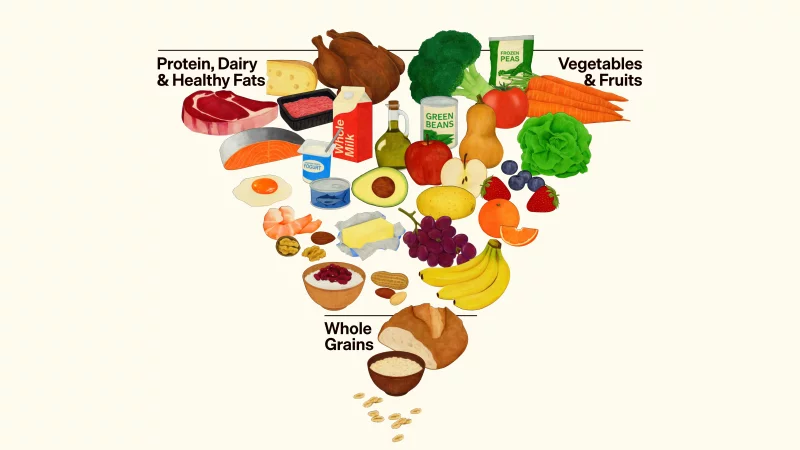
The Department of Health and Human Services (HHS) and the U.S. Department of Agriculture (USDA) have released sweeping new federal food guidelines that sharply pivot U.S. nutrition policy toward “real food,” higher protein, and full‑fat dairy while warning Americans to avoid highly processed products and added sugars. Framed by the Trump administration as a “historic reset” of how the nation eats, the 2025–2030 Dietary Guidelines for Americans are expected to influence everything from school lunches to hospital menus and food assistance programs.

“The goal is to eat real food,” said Kyle Diamantas, Deputy Commissioner for Human Foods, FDA, on a MAHA Action call. “It is important to cut down on ultra-processed foods. This is not a new iteration in past science. It is a fundamental shift. The policies of the past have failed us. This is a monumental win for RFK, Jr and HHS.”
Big shift toward “real food”
The new guidelines center on whole, nutrient‑dense foods—such as meat, eggs, seafood, beans, nuts, vegetables, fruits, whole grains, and dairy—as the cornerstone of a healthy diet. HHS emphasizes minimizing “highly processed” and “ultraprocessed” products, including packaged snacks, sugary drinks, and ready‑to‑eat meals high in refined carbohydrates, sodium, and additives.


Officials say the changes aim to tackle obesity and diet‑related chronic disease by simplifying public advice: eat food that looks close to how it started on the farm, and cut back sharply on sugar‑sweetened beverages, candies, and refined starches.
Protein and full‑fat dairy elevated
For the first time, the guidelines explicitly tell Americans to prioritize protein at every meal, recommending roughly 1.2 to 1.6 grams of protein per kilogram of body weight per day—substantially higher than previous targets. Suggested protein sources include eggs, poultry, seafood, red meat, and plant‑based options like beans, nuts, and seeds, with a warning to avoid added sugars and heavy processing.
Dairy remains at three servings per day for a typical 2,000‑calorie diet, but the guidance now favors full‑fat options with no added sugar over the low‑fat or fat‑free products that dominated earlier recommendations. The administration describes this as “ending the war on healthy fats,” encouraging fats from meat, fish, eggs, nuts, olives, avocados, and full‑fat dairy.
Processed foods, sugar, and alcohol curbed
The guidelines “name and shame” highly processed foods, urging Americans to avoid snack foods like chips, cookies, and candy that pack added sugars and sodium into small portions. Refined carbohydrates are to be sharply reduced, with an emphasis instead on whole grains—about two to four servings per day—alongside fruits and vegetables.
While the guidance reiterates that “less alcohol is better for health,” it drops the previous numeric daily drink limits, instead broadly advising people to reduce alcohol consumption without specifying a maximum. Sugary beverages, including sodas, fruit drinks, and energy drinks, are singled out as products to limit or avoid.
What’s on the plate now
For a typical 2,000‑calorie diet, the new guidelines recommend at least three servings of vegetables and two servings of fruit each day, continuing long‑standing advice to fill plates with produce. Whole grains, fiber‑rich foods, and home‑cooked meals are encouraged, while fast food and prepackaged meals should be occasional rather than routine.
A new inverted food pyramid visually elevates protein and dairy to more prominent positions, signaling that these foods should feature more prominently in daily eating patterns than in previous federal graphics. Federal agencies say the icon will guide updates to educational materials in schools, clinics, and community programs over the coming years.
Praise, pushback, and what’s next
The Trump administration and senior HHS and USDA officials call the guidelines a long‑overdue correction that puts “food, not pharmaceuticals” at the center of disease prevention and public health. Hospital groups and some nutrition advocates welcomed the stronger stance against added sugars and ultraprocessed foods, calling it a step toward more wholesome diets for families.
But some cardiology and nutrition experts warn that the embrace of full‑fat dairy and animal fats could raise cardiovascular risk if Americans increase saturated fat intake without restraint, urging people to favor plant‑based proteins, seafood, and lean meats. The guidelines, which are updated every five years, will now move into the implementation phase, shaping standards for programs like school meals, WIC, and SNAP across the country.

“This is the most significant reset of food policy in decades, said Stefanie Spear, Senior Counselor for the Office of the Secretary in the Department of Health and Human Services. “Today marks a decisive change to revolutionize America’s food culture. The message is clear: ‘Eat real food.’ Buckle up. We have much more to come.”


