

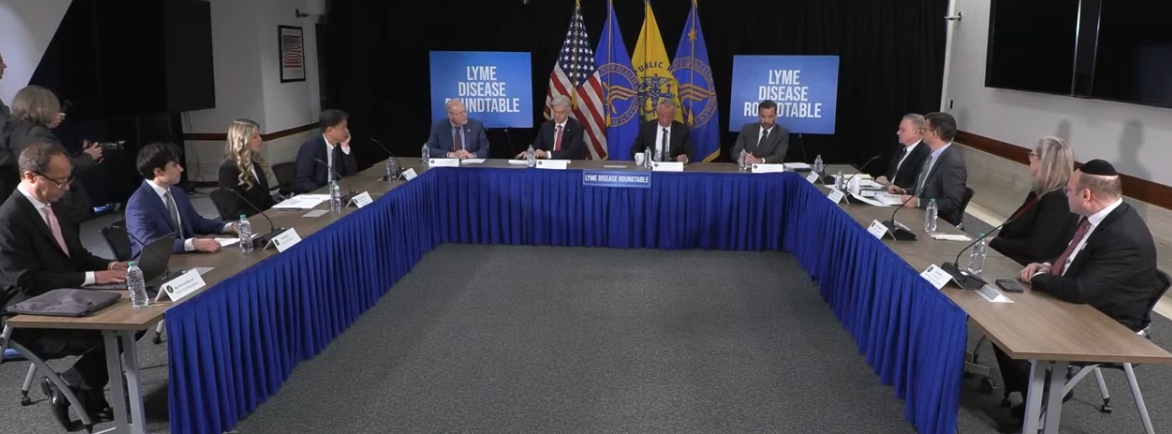
Health and Human Services Secretary Robert F. Kennedy Jr. is giving Lyme disease far more political visibility and federal attention than it has had in years. HHS convened Lyme disease patients, clinicians, and researchers for a roundtable on diagnostics and clinical needs moderated by HHS Secretary Robert F. Kennedy, Jr. The event fulfills commitments made in the Make America Healthy Again Commission Strategy Report to address chronic and often unseen illnesses that affect millions of Americans.
“For decades, Americans suffering from Lyme disease have been denied the accurate diagnostics and meaningful care they deserve,” said Secretary Kennedy. “Today’s actions push us decisively toward reliable testing and treatment grounded in the real-world experiences of patients. We are committed to delivering the tools that families have waited far too long to receive.”

A spotlight on an “invisible illness”
At a December 15 “Invisible Illness” roundtable, Secretary Kennedy told a room of patients, clinicians and lawmakers that “the gaslighting of Lyme patients is over,” casting the event as a turning point in how Washington treats the tick‑borne disease. He described Lyme as a condition long ignored by previous administrations. He recounted how members of his own family were infected while living in New York’s Hudson Valley, a hot spot for the illness. “These are people who genuinely are ill,” he said, accusing the health system of dismissing them and steering many toward psychiatric care rather than medical answers.


The roundtable, live‑streamed by HHS, drew senior agency officials, the heads of major Lyme organizations, and members of Congress from high‑incidence states such as Maine and New Jersey. Organizers framed the discussion as the beginning of a more patient‑centered federal approach to Lyme and related chronic conditions that continue to affect hundreds of thousands of Americans each year.
New initiatives and long‑standing gaps
Kennedy used the event to announce or highlight a series of policy moves, including renewal of the LymeX Innovation Accelerator, a public‑private partnership initially launched in 2020 to spur better diagnostics. HHS officials also pointed to a shift in Medicare’s chronic care guidelines to explicitly cover chronic Lyme disease management, a change patient groups hailed as long‑sought recognition of ongoing symptoms after initial treatment.
Federal scientists at the table underscored that research is already underway. National Institutes of Health director Jay Bhattacharya noted an ongoing clinical study using neuro‑imaging and blood markers to better understand neurological symptoms associated with Lyme, and he previewed a formal federal “Lyme disease framework” expected in early 2026. Yet clinicians and advocates repeatedly returned to one persisting problem: existing antibody‑based tests miss cases, especially early in infection, leaving patients without timely treatment and sometimes facing long‑term complications.
Lyme has infected an estimated five to seven million Americans over the past decade. CDC estimates that 476,000 Americans are diagnosed and treated for Lyme disease each year. Current tests often miss early or late-stage infection, which limits access to appropriate evaluation and care. For up to 20 percent of patients, symptoms persist and progress into Lyme infection-associated chronic conditions and illnesses.
For some a controversial messenger
Kennedy’s message comes just a year after he publicly advanced the theory that Lyme disease was “highly likely” to have been developed as a military bioweapon at a Long Island research facility. He has also accused federal agencies of deliberately downplaying the disease, asserting that top officials once claimed “Lyme disease did not exist,” even as the Centers for Disease Control and Prevention maintained a detailed Lyme information page and the National Institutes of Health funded multiple research projects on post‑treatment Lyme syndrome.
Patient advocates cautiously hopeful
Many in the Lyme community describe the HHS roundtable as a milestone. Groups such as Global Lyme Alliance and Project Lyme, which participated in the discussions, praised the emphasis on patient testimony and the explicit federal acknowledgment that people can remain sick after standard treatment. One advocate called the event “a pivotal moment,” pointing to announced plans for Centers of Excellence and stronger coordination across agencies as signs that Lyme is finally being treated like other serious chronic illnesses.
Patients and clinicians on the panel highlighted the financial and emotional toll of years‑long diagnostic odysseys, with some describing how families exhausted savings on therapies of uncertain benefit. A provider working on a rapid test for tick‑borne diseases said she hoped to bring a 20‑minute point‑of‑care assay to retail pharmacies, underscoring how basic diagnostic gaps still shape everyday care.
For now, Kennedy has given Lyme patients something they have long said they lacked: a seat at the table and a health secretary willing to declare their illness real and worthy of federal action, in front of cameras and colleagues. Whether that symbolic shift becomes the kind of durable, science‑grounded progress patients have demanded for decades remains an open—and urgent—question.
“Today’s roundtable shows we have solid commitment from Secretary Kennedy, Dr. Oz and lawmakers to address Lyme disease and other tickborne illnesses in the United States. As someone who has Alpha-Gal Syndrome, I have some understanding of the health challenges that result from tickborne illnesses,” said Representative Morgan Griffith (R-VA). “It is important to research potential treatments and to educate the public on these illnesses. As Health Subcommittee Chairman, I will continue pushing for policies that help us accomplish these goals.”
HHS also announced that the Centers for Medicare & Medicaid Services (CMS) has provided guidance to clarify they support beneficiaries with Lyme disease and related conditions through the Chronic Care Management program. This support expands access to coordinated care and reduces financial barriers for Medicare patients with complex, long-term conditions.
HHS is advancing a national effort that uses current science to strengthen prevention, diagnosis, and long-term care for people affected by Lyme disease and other infection-associated chronic conditions.


