

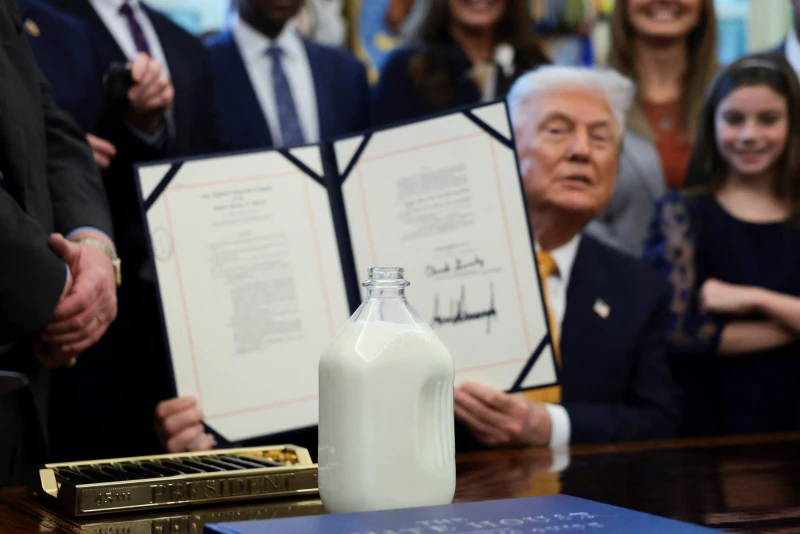
President Donald Trump on Wednesday signed the Whole Milk for Healthy Kids Act of 2025 into law, clearing the way for whole and 2% milk to return to school cafeterias nationwide for the first time in more than a decade. The move rolls back Obama-era nutrition rules that had restricted schools participating in the National School Lunch Program to low-fat and fat-free milk options.
Bill signing at White House
Flanked by dairy farmers, lawmakers, and children holding small milk cartons, Trump cast the new law as a win for families and his administration’s “Make America Healthy Again” agenda. “Whether you’re Democrat or Republican, milk is a great thing,” Trump said at the White House ceremony, standing beside a large jug of milk on the Resolute Desk. He added that the legislation would “guarantee that millions of school‑aged children will have access to high‑quality milk as we ‘Make America Healthy Again.’
What the new law does
The Whole Milk for Healthy Kids Act modifies federal school meal standards to allow schools in the National School Lunch Program to serve whole and 2% milk alongside existing skim and 1% options. The change applies to nearly 30 million students who participate in school breakfast and lunch programs each day. The law also gives schools more flexibility to offer nondairy milk substitutes that meet nutritional standards and lets parents request milk alternatives with a note, rather than requiring a doctor’s note as before.

Reversing Obama-era policy
The new statute undoes key pieces of the Healthy, Hunger‑Free Kids Act of 2010, championed by former First Lady Michelle Obama, which had effectively removed whole and 2% milk from federally reimbursed school meals over concerns about saturated fat and childhood obesity.
“Dairy farmers and their cooperatives couldn’t be more thrilled that whole and 2% milk is returning to school meals,” said Gregg Doud, president and CEO of the National Milk Producers Federation. “Dairy is a nutrition powerhouse that should be used to its fullest potential — and that means making it available in the same varieties families consume at home.”
Dairy industry and bipartisan backing
Dairy groups, which have lobbied for years to restore higher‑fat milk to school menus, applauded the signing as a landmark victory. “Today marks significant progress in enhancing the nutrition of American schoolchildren,” said Gregg Doud, president and CEO of the National Milk Producers Federation, praising what he called a “historic, years‑long effort” by farmers, companies, nutrition leaders, and parents to restore the milk options “children overwhelmingly prefer.” The bill passed Congress with broad bipartisan support after the House previously approved the measure 330–99 and the Senate advanced a companion version led by Sen. Roger Marshall, R‑Kan., and Sen. Peter Welch, D‑Vt.
Michael Dykes, president and CEO of IDFA, said: “The long wait is over! Whole milk is coming back to schools! This law is a win for our children, parents, and school nutrition leaders, giving schools the flexibility to offer the flavored and unflavored milk options across all healthy fat levels that meet students’ needs and preferences.”
Health officials’ rationale
Health and Human Services Secretary Robert F. Kennedy Jr. described the law as “a long‑overdue correction to school nutrition policy,” arguing that updated science supports full‑fat dairy as part of a healthy diet. Agriculture Secretary Brooke Rollins, a vocal whole‑milk supporter, said the measure “rectifies Michelle Obama’s short‑sighted campaign to eliminate whole milk” from schools. The administration’s newly released Dietary Guidelines for Americans emphasize “full‑fat dairy with no added sugars,” signaling a move away from earlier recommendations that children over age 2 consume only low‑fat or fat‑free dairy products.

