

WASHINGTON — The U.S. Department of Health and Human Services has frozen all federal child care funding for Minnesota and ordered a sweeping audit of the state’s child care system, citing mounting concerns about possible large‑scale fraud in programs serving low‑income families and vulnerable adults. The unprecedented move threatens payments that help tens of thousands of Minnesota families afford child care and has triggered a fierce political clash between the Trump administration and state leaders.
In a letter to Gov. Tim Walz, HHS officials said they were halting all federal child care payments to the state while auditors dig into records from a broad range of providers, including day care centers and adult day‑type programs that have rapidly expanded in recent years. The department is demanding extensive documentation, from attendance logs and billing records to inspection reports and prior complaints, as it examines whether some providers billed taxpayers for children or clients who were never actually present.
Scope of programs and money at stake
Minnesota receives roughly $185 million a year in federal child care funding, money that flows through state agencies to subsidize care for low‑income families and to support licensing, safety training and oversight of providers across the state. State officials and industry groups warn that the sudden freeze could disrupt care for an estimated 19,000 to 30,000 children, forcing some centers to cut staff, slash hours or close altogether in a state that already faces persistent child care shortages.

Fraud concerns and rapid growth
Federal authorities say their decision was driven by a growing body of allegations that Minnesota has become a hot spot for fraud in publicly funded care programs, from child care subsidies to other human services. Investigators are particularly focused on providers whose revenues and client counts surged at a pace that far outstripped documented demand, a pattern officials describe as a red flag for schemes in which operators claim reimbursement for services that were never delivered.
The latest scrutiny intensified after a viral online video by conservative commentator Nick Shirley, who filmed a series of Minnesota day care sites that appeared largely empty despite, he claimed, receiving substantial public payments. The footage fueled conservative criticism that state regulators had failed to act on warning signs and helped galvanize support inside the Trump administration for a hard line on Minnesota’s use of federal funds.
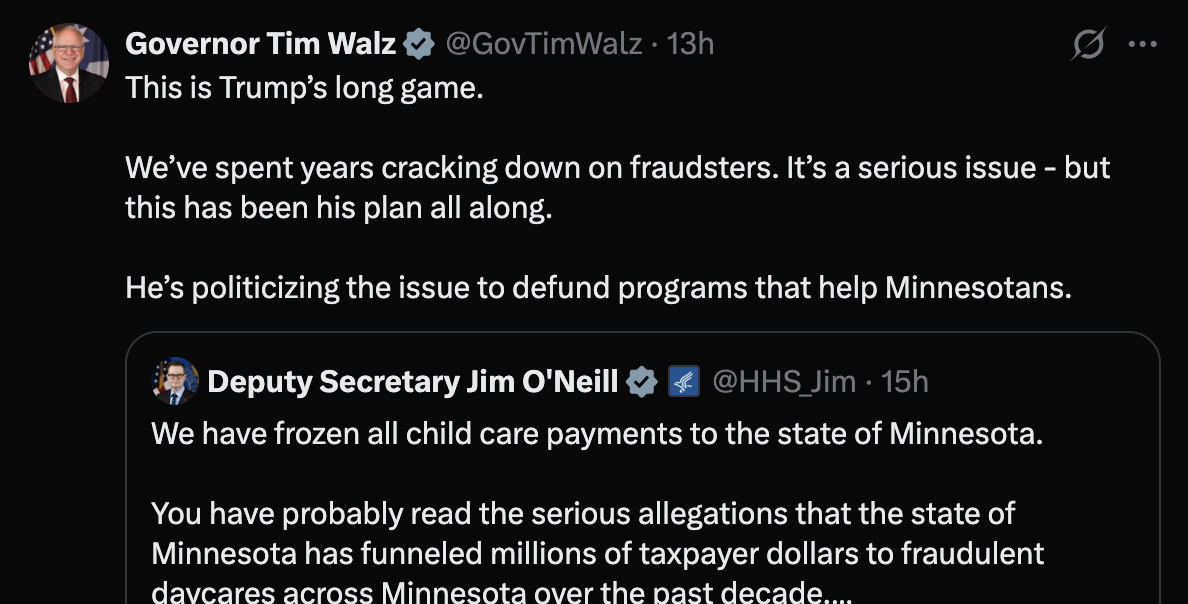
HHS took action against what it alleged was “blatant fraud that appears to be rampant in Minnesota and across the country,” Deputy Secretary of Health and Human Services Director Jim O’Neil said in a post on X on Tuesday, Dec. 30.
Gov. Walz, a Democrat, has sharply criticized the federal action as reckless and politically motivated, accusing the administration of using Minnesota families as leverage in a broader partisan fight over fraud and welfare programs. Walz insists the state has already increased oversight, boosted its own investigative capacity and moved to crack down on bad actors, arguing that a blanket funding freeze punishes legitimate providers and the families who rely on them.
Advocates for parents and child care workers say they are caught in the crossfire. Providers warn that without federal reimbursements, many centers lack the cash reserves to keep paying staff and rent, while families fear being forced to quit jobs or reduce hours if they suddenly lose access to affordable care.
Minnesota’s human services agency has pledged to cooperate with the audit while simultaneously exploring legal and administrative options to restore federal funding as quickly as possible. State lawmakers from both parties have called for emergency hearings early in the new year, signaling that the fallout from the freeze and the fraud allegations behind it is likely to dominate Minnesota’s political agenda for months to come.

